

Pediatric Vision Care
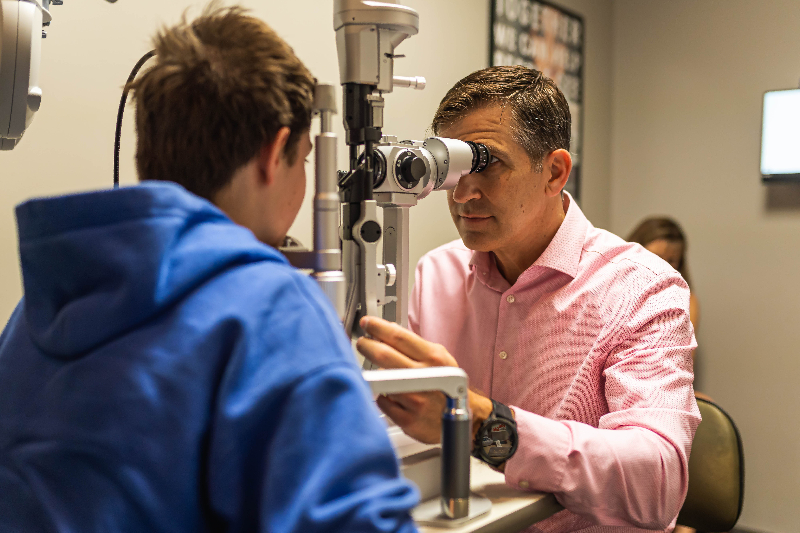
Children's Eye Exams: Building a Foundation for Healthy Vision
Routine comprehensive eye exams are an important part of your child's overall health, development, and success in school. What many parents don't realize is that school vision screenings and pediatrician screenings are not a substitute for a comprehensive eye examination.
Even children with 20/20 vision can have underlying vision problems that may affect their learning, development, and everyday activities. A comprehensive eye exam allows your optometrist to evaluate more than just how clearly your child sees.
When Should Your Child Have an Eye Exam?
A child's vision develops rapidly during the early years of life, making routine eye exams essential for identifying potential concerns as early as possible.
The American Optometric Association (AOA) recommends comprehensive eye examinations at the following ages:
Between 6 and 12 months
At 3 years of age
Before starting kindergarten
Every two years throughout the school years, unless more frequent examinations are recommended by your eye doctor
Newborns also receive an initial eye health assessment before leaving the hospital.
What Does a Children's Eye Exam Include?
A comprehensive children's eye exam evaluates several aspects of vision and eye health. Because children may not always recognize or communicate vision difficulties, these evaluations help identify concerns that might otherwise go unnoticed.
Depending on your child's age and needs, an examination may include:
Visual Acuity: Measures how clearly your child sees objects at different distances.
Refractive Status: Checks for nearsightedness (myopia), farsightedness (hyperopia), and astigmatism.
Eye Health: Evaluates the overall health of the eyes and checks for signs of disease or developmental abnormalities.
Eye Tracking: Assesses how well the eyes follow moving objects and move between words or objects.
Eye Focusing: Evaluates the ability to change and maintain focus when looking at objects near and far.
Eye Teaming: Determines how well both eyes work together to provide comfortable, coordinated vision and depth perception.
Our doctors evaluate these important visual skills to help support healthy vision development and identify potential problems early.
Supporting Your Child's Full Visual Development
Vision involves much more than seeing clearly. It is a complex process in which the eyes and brain work together to interpret information and guide how we interact with the world.
There are three key areas of visual development:
Visual Acuity: The ability to see clearly, influenced by eye health and refractive status.
Visual Efficiency: The ability to focus, track, and coordinate both eyes comfortably and accurately.
Visual Information Processing: The ability to recognize, interpret, and understand what we see.
At Vision Source Studio 20/20, our doctors consider all three areas when evaluating children's vision. We understand that healthy visual development plays an important role in reading, learning, hand-eye coordination, and everyday activities.
Is Your Child Having Trouble Seeing?
Vision problems in children aren't always easy to recognize. While some symptoms are noticeable, others can be subtle and may even be mistaken for behavioral or learning difficulties.
Your child may be experiencing a vision problem if they:
Avoid reading or close-up activities such as coloring, puzzles, or homework.
Have difficulty completing visual tasks or seem to work more slowly than expected.
Frequently complain of headaches or eye fatigue.
Have a short attention span or become easily distracted during reading or schoolwork.
Cover one eye or tilt their head when looking at something.
Show sensitivity to light.
Have difficulty with coordination or hand-eye activities.
If you notice any of these behaviors, scheduling a comprehensive eye exam can help determine whether an underlying vision problem may be contributing.
Why Early Eye Exams Matter
Infants and Early Childhood
Vision development begins at birth and continues throughout childhood. Even before children can recognize letters or read an eye chart, specialized testing allows optometrists to evaluate their visual development and overall eye health.
Early examinations can help identify developmental concerns and conditions that may affect vision if left untreated.
School Performance and Learning
Healthy vision plays an important role in a child's ability to learn. Reading, writing, focusing, and participating in classroom activities all depend on well-developed visual skills.
Research has shown that vision problems are common among school-aged children and may contribute to difficulties with learning and academic performance. Identifying and addressing these concerns early can help children reach their full potential.
Hand-Eye Coordination and Development
Children rely on their vision to explore their surroundings, recognize movement, develop spatial awareness, and coordinate their movements. Visual difficulties can interfere with these important developmental skills.
Evaluating visual development during routine eye exams helps identify concerns that may affect coordination and everyday activities.
Common Eye Conditions in Children
Several eye conditions can affect a child's vision and development. Many can be successfully managed when identified early.
Some of the most common include:
Strabismus (Crossed Eyes): A condition in which the eyes are misaligned and do not point in the same direction.
Amblyopia (Lazy Eye): Reduced vision in one or both eyes caused by abnormal visual development during childhood. It often develops when one eye is weaker than the other and may occur alongside strabismus or significant differences in prescription.
Refractive Errors: Vision problems caused by the shape of the eye or its focusing structures. These conditions are commonly corrected with prescription eyewear.
The three main types of refractive errors are:
Myopia (Nearsightedness): Distant objects appear blurry, while close-up objects are generally easier to see.
Hyperopia (Farsightedness): Close-up objects may appear blurry or require additional focusing effort.
Astigmatism: An irregular curvature of the cornea or lens causes blurred or distorted vision at near and far distances.
Early detection and appropriate treatment can make a significant difference in a child's long-term vision and eye health.
Give Your Child the Best Start with Healthy Vision
Your child's vision plays an essential role in how they learn, grow, and experience the world. Regular comprehensive eye exams help ensure their eyes are developing properly and give them the best opportunity to succeed in school and beyond.
At Vision Source Studio 20/20, we're committed to supporting your child's vision at every stage of development.
Schedule your child's comprehensive eye exam today!
Services
Learn More
Keep In Touch
Contact UsVisit Us Our Locations
(704) 295-4443
Ballantyne is currently booked until 2027, but you can call or text us to get added to the waitlist!
Hours
- Monday8:00am - 5:00pm
- Tuesday8:00am - 5:00pm
- Wednesday8:00am - 5:00pm
- Thursday10:00am - 7:00pm
- Friday8:00am - 1:00pm
- SaturdayCLOSED
- SundayCLOSED

(704) 510-9239
Hours
- Monday8:00am - 5:00pm
- Tuesday8:00am - 5:00pm
- Wednesday8:00am - 5:00pm
- Thursday10:00am - 7:00pm
- Friday8:00am - 1:00pm
- SaturdayCLOSED
- SundayCLOSED

© 2026 Vision Source Studio 20/20. All rights Reserved. Accessibility Statement - Privacy Policy - Sitemap
Managed and Designed By
